In short
- Nagarahole Tiger Reserve lies directly north-west of Bandipur across the Kabini reservoir. It covers 843.96 km² in the Mysuru and Kodagu districts, including a 643.39 km² core, and is run by the Karnataka Forest Department from Hunsur.
- Kabini is the name everyone uses for the reserve's southern side, on the backwaters of the Kabini dam (1974). In the dry months the receding shoreline draws elephants, gaur and deer to the water, which is why it is among the most sought-after safari areas in India.
- Safaris (official ticket site, checked November 2026): three gates. Kakanakote, the Kabini gate, runs 06:30–09:30 and 15:00–18:00; Veeranahosahally and Nanachi run 06:00–09:00 and 15:00–18:00. Bus ₹1,000 and jeep ₹1,500 per adult, half for children aged 3–12. Bookings open 15 days ahead and close 48 hours before.
- Mobile phones are banned in the core safari zones and foreign visitors must show a passport. Like Bandipur's, Nagarhole's safaris were suspended from November 2025, partly reopened in February 2026 and approved for full operation in June 2026.
- From Bandipur, Kabini is a separate trip, not a day add-on. Most people go for two nights. A two-day Kabini tour from Bengaluru and a multi-day circuit including Kabini are on GetYourGuide.
What and where Nagarhole is
Look at a map of the forests south of Mysuru and you see one green block broken by a long, branching lake. The lake is the Kabini reservoir, formed when the Kabini river was dammed in 1974. South and east of it is Bandipur; north and west of it is Nagarahole Tiger Reserve, still widely called Nagarhole or by its former name, Rajiv Gandhi National Park. The name means serpent river in Kannada, after the winding stream that runs through it.
The reserve's official site describes it as contiguous with Wayanad Wildlife Sanctuary in Kerala to the south and with Bandipur to the south-east, and as a corridor linking the Western Ghats through the Brahmagiri sanctuary with the Eastern Ghats through Bandipur. With Mudumalai and Wayanad these forests form the core of the Nilgiri Biosphere Reserve, and one of the largest tiger and Asian elephant populations anywhere.
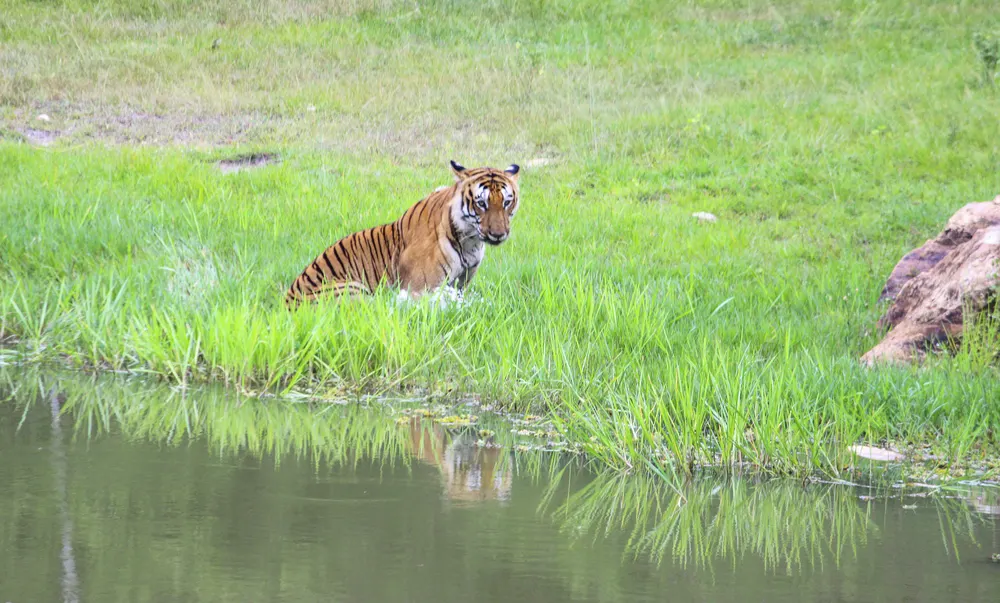
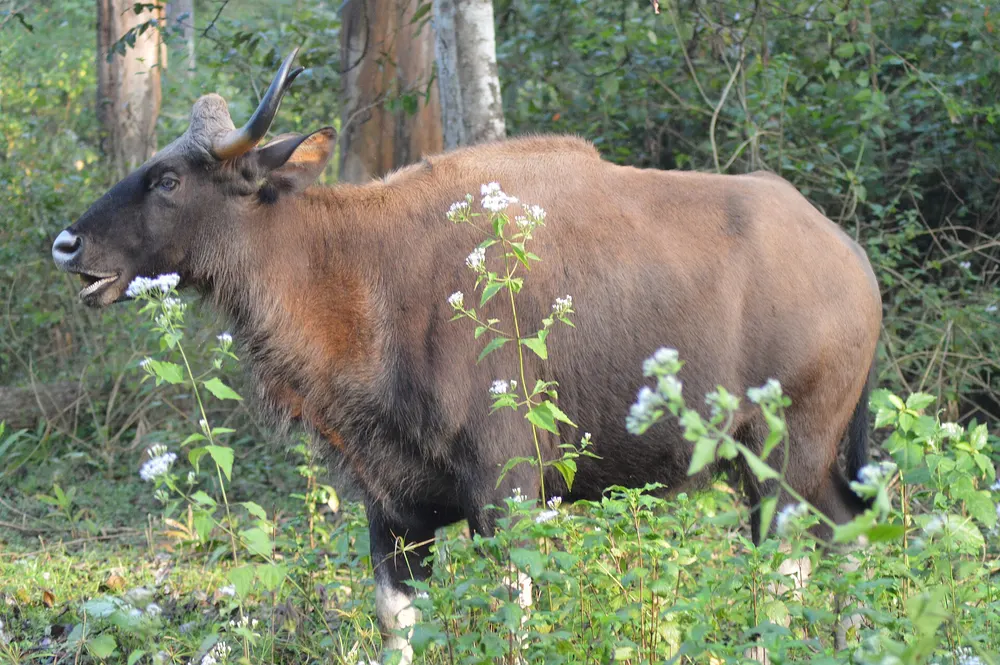
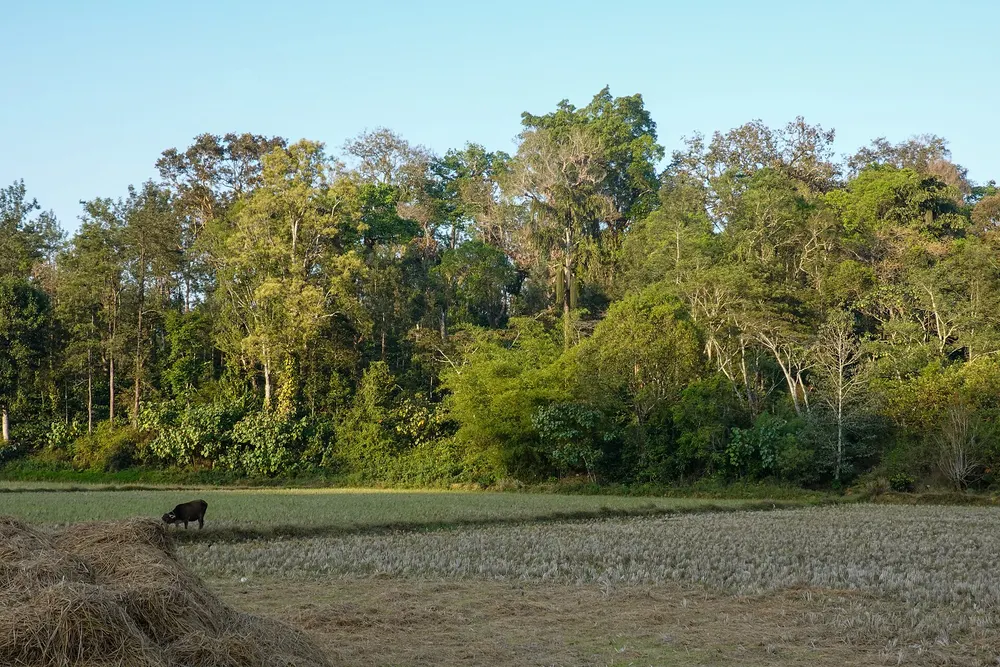
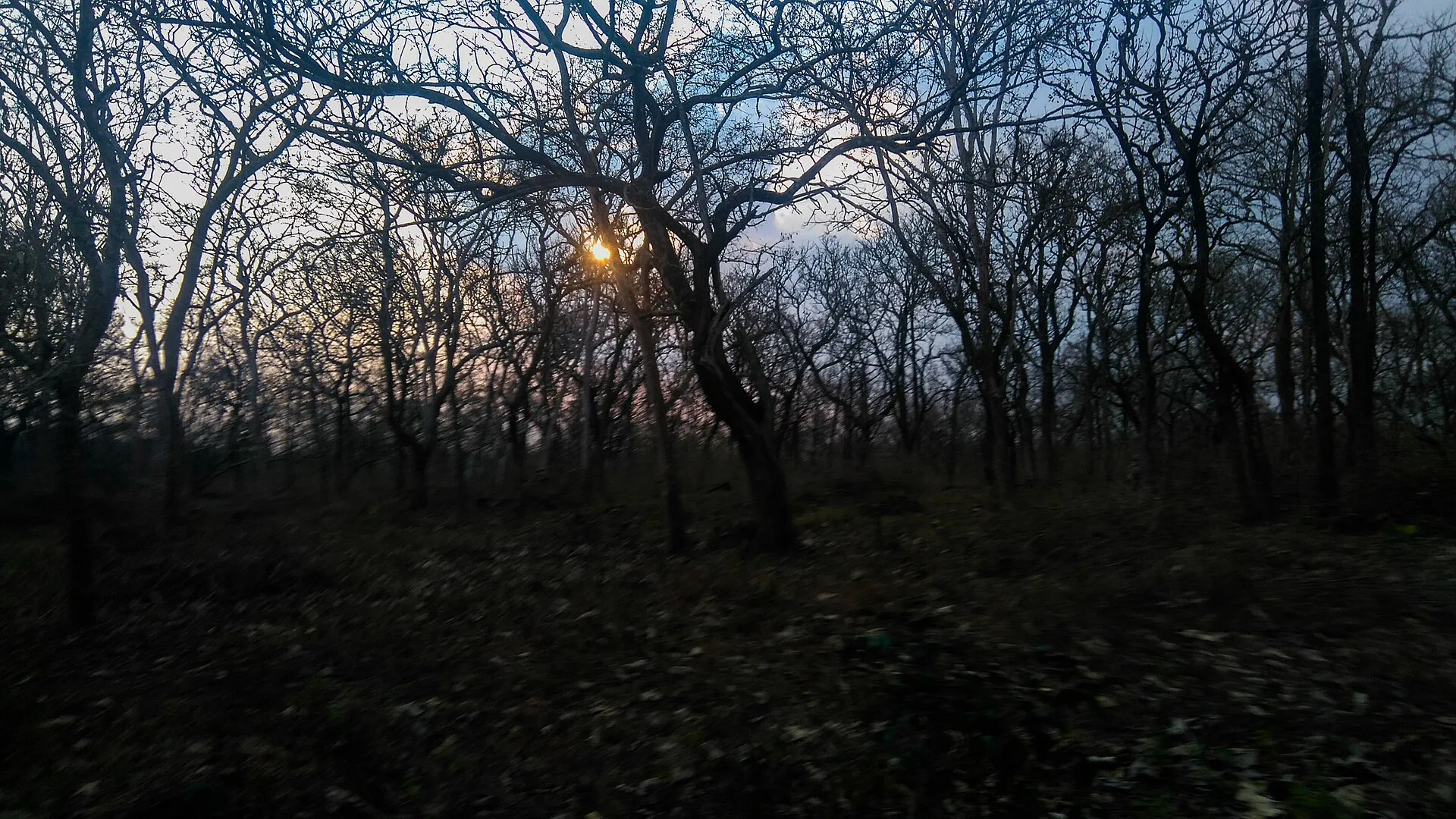
Nagarhole is wetter and greener than most of Bandipur: tall moist deciduous forest with teak, rosewood and bamboo in the west and north, drier forest towards the reservoir. The Forest Department lists tiger, leopard, dhole and sloth bear among its carnivores, and Asian elephant, gaur, sambar, chital, muntjac, four-horned antelope, wild pig, mouse deer and langurs among its herbivores.
- Area
- 843.96 km²: core (critical tiger habitat) 643.39 km², buffer 204.59 km² (2012)
- Districts
- Mysuru and Kodagu, Karnataka
- Managed by
- Karnataka Forest Department; Director's office at Hunsur
- Protected since
- Sanctuary 1955; national park 1983; tiger reserve 2003 (independent from 2007)
- Tigers
- 2022 national assessment: estimate 185; 141 individually photographed by camera traps
- Kabini dam
- Built 1974; 696 m long (reserve website)
- Safari booking
- Official ticket site linked from nagaraholetigerreserve.com
From hunting reserve to tiger reserve
Like Bandipur, Nagarhole was a hunting forest of the Mysore and Coorg rulers before it was a park. The reserve gives its own history: in 1955 about 285 km² of forest in what was then Coorg state was declared a wildlife sanctuary; in 1983 it was upgraded to a national park of 571.55 km²; in 1986 it became part of the Nilgiri Biosphere Reserve; and in 2000 it was included under Project Elephant as part of the Mysore Elephant Reserve.
In 2003 71.84 km² were added, giving the present national park of 643.39 km², and Nagarhole joined Project Tiger as an extension of Bandipur. In 2007 it was declared an independent tiger reserve, and in 2012 the state notified a buffer of 204.59 km², bringing the total under the reserve's administration to 843.96 km².
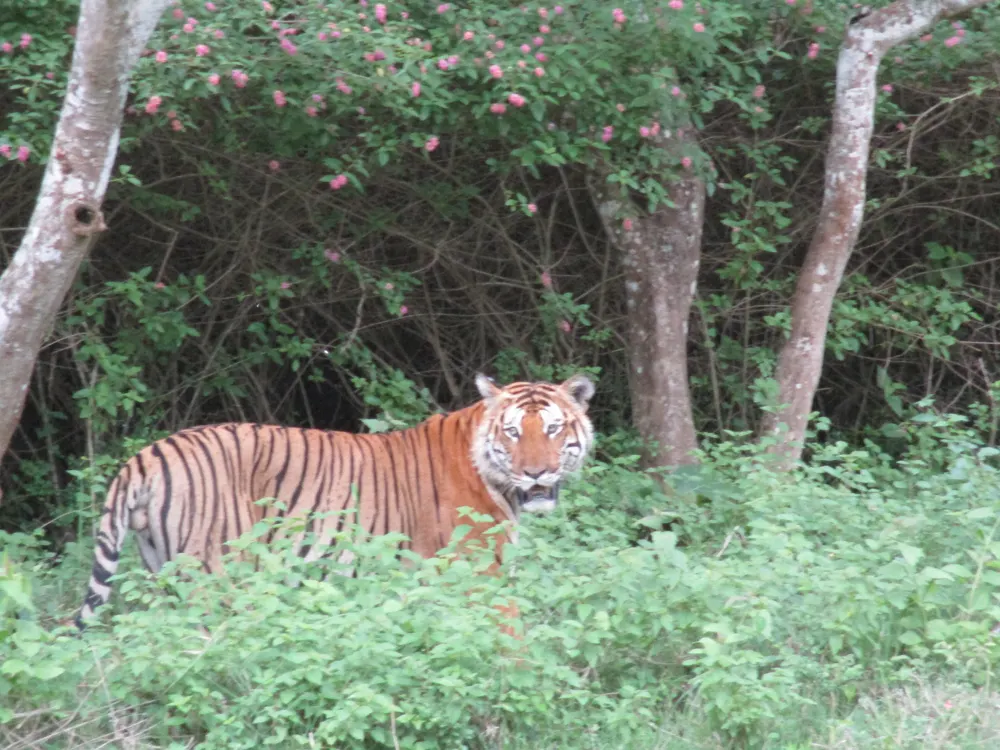
The reserve calls its tiger population one of the highest-density in India after Corbett and Kaziranga. The national 2022 assessment by the National Tiger Conservation Authority and the Wildlife Institute of India estimated 185 tigers in Nagarhole, with 141 individually photographed by camera traps, close behind Bandipur's 191 (150 photographed). The tigers page explains what these numbers mean for sightings.
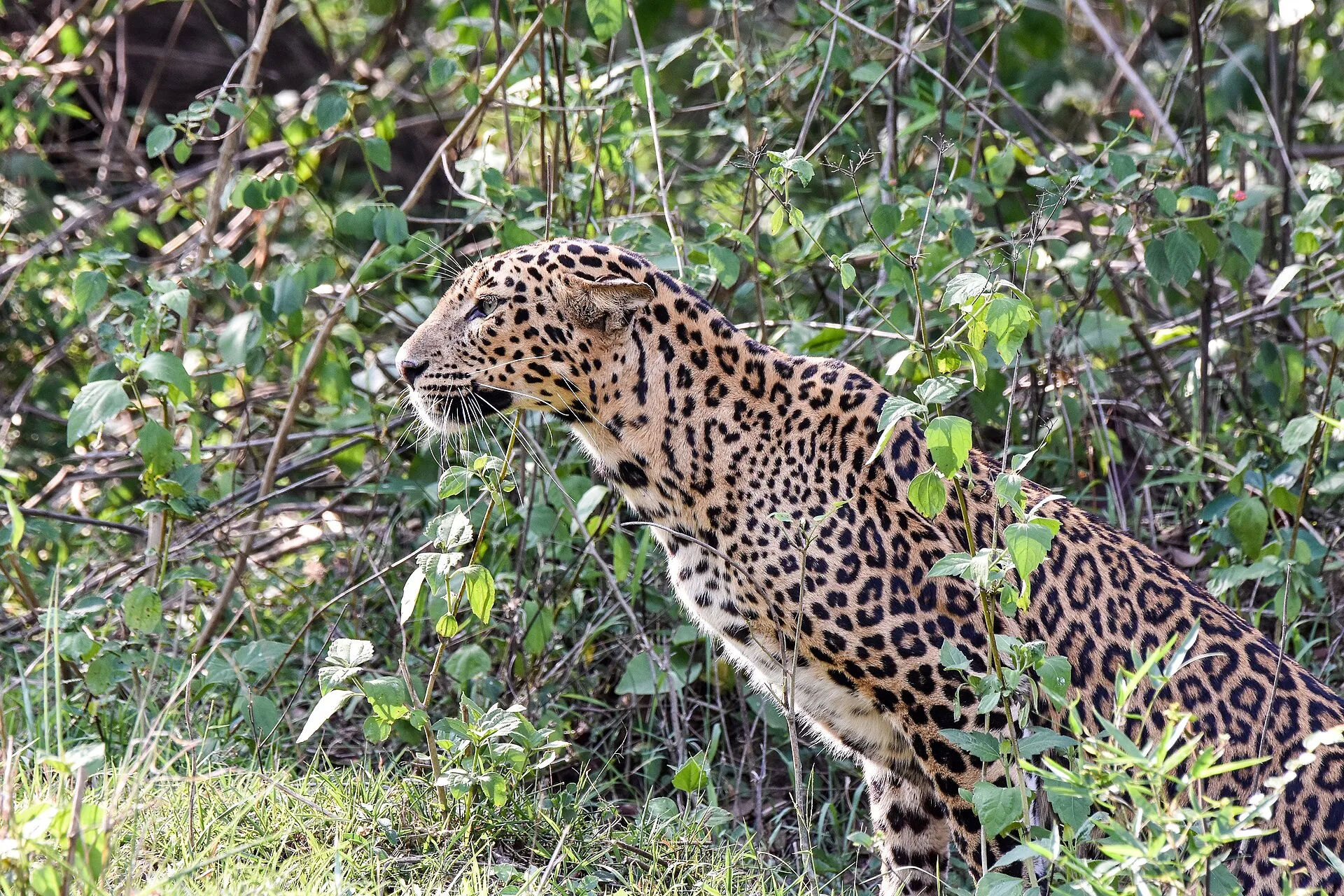
A female leopard in Nagarhole, April 2022. Leopards are seen regularly on the Kabini side, often in trees by the safari roads.
The Kabini backwaters
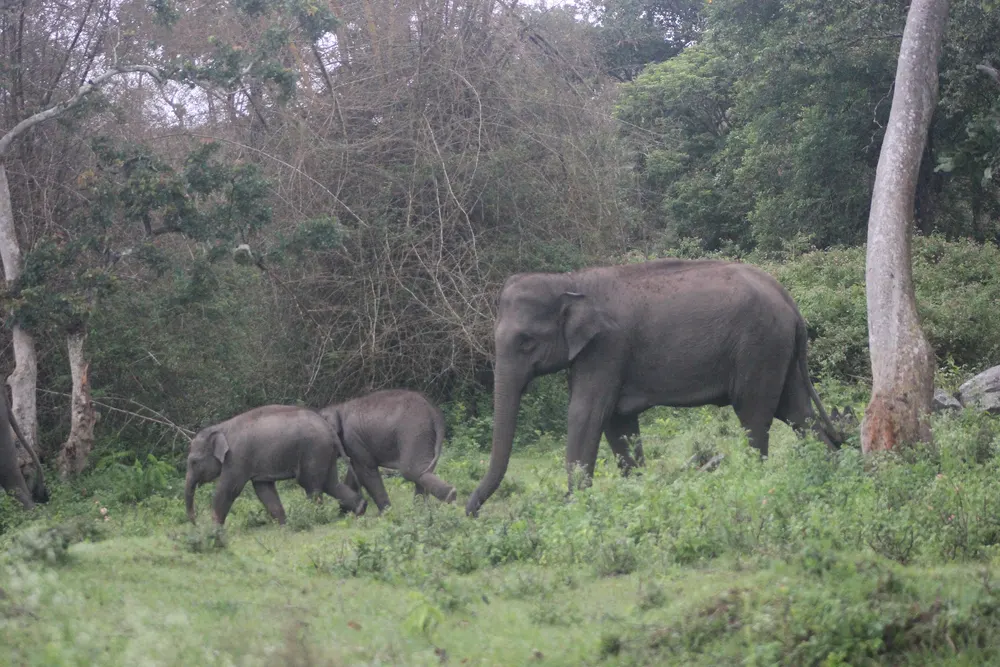
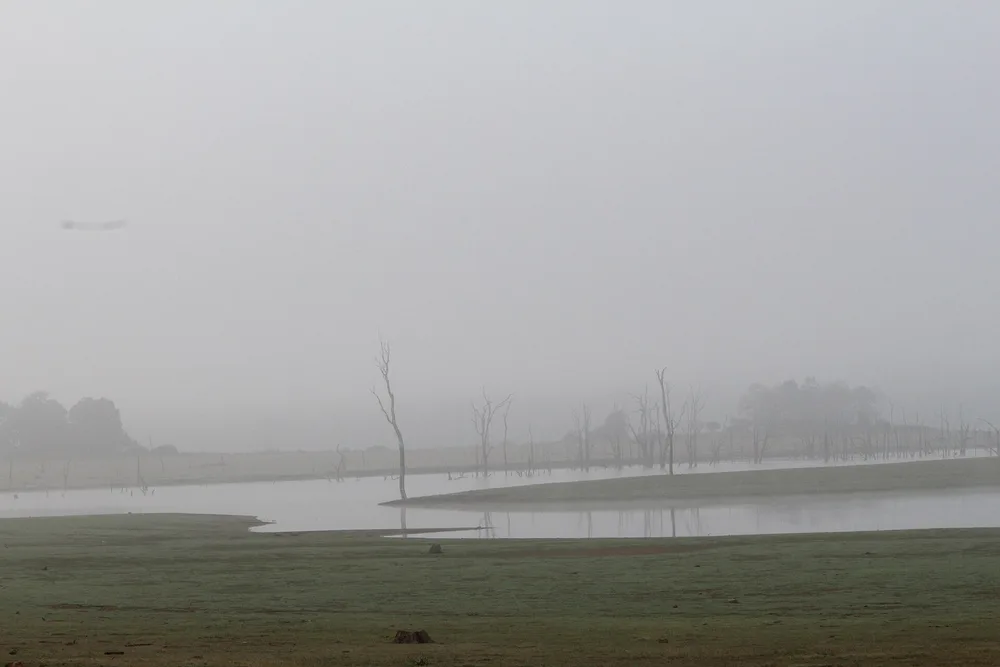
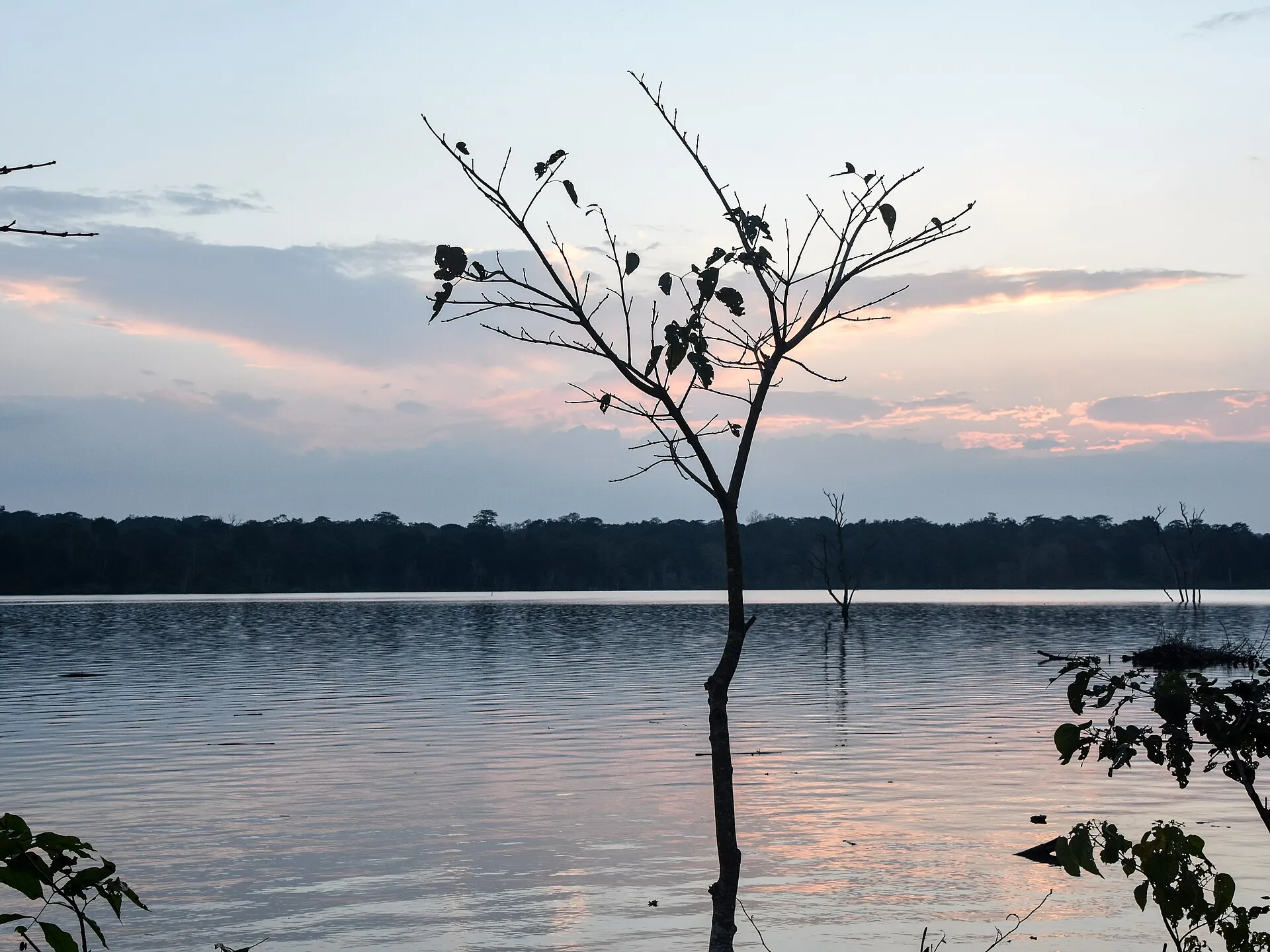
Kabini's fame comes from the water. When the dam fills after the monsoon, the reservoir floods deep into the forest. As it drains through the dry season, from about February to June, the water's edge retreats and leaves wide meadows of fresh grass between the trees and the shore. Elephants come down to drink, bathe and graze on these flats, often in large family groups, along with gaur, chital and sambar, and predators follow the prey. On a good afternoon in April or May you can see more elephants in an hour than in days elsewhere.
That is the scene in most Kabini photographs, and it is a seasonal one. After heavy monsoon rain the reservoir is full, the meadows are under water and animals spread through the forest; sightings are more scattered from about July to October.
The other Kabini experience is a boat on the backwaters. Jungle Lodges & Resorts, the Karnataka government's eco-tourism company, says on its own site that its Kabini River Lodge, once a hunting lodge of the Mysore maharajas, offers guests a boat ride on the Kabini to see elephants, crocodiles and birds as well as jeep safaris. Boat trips are tied to lodge stays and their terms change; ask your lodge what is currently allowed.
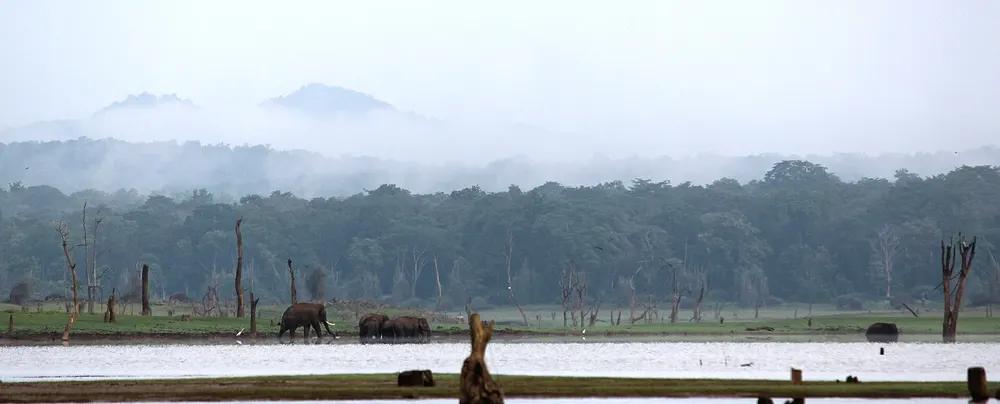
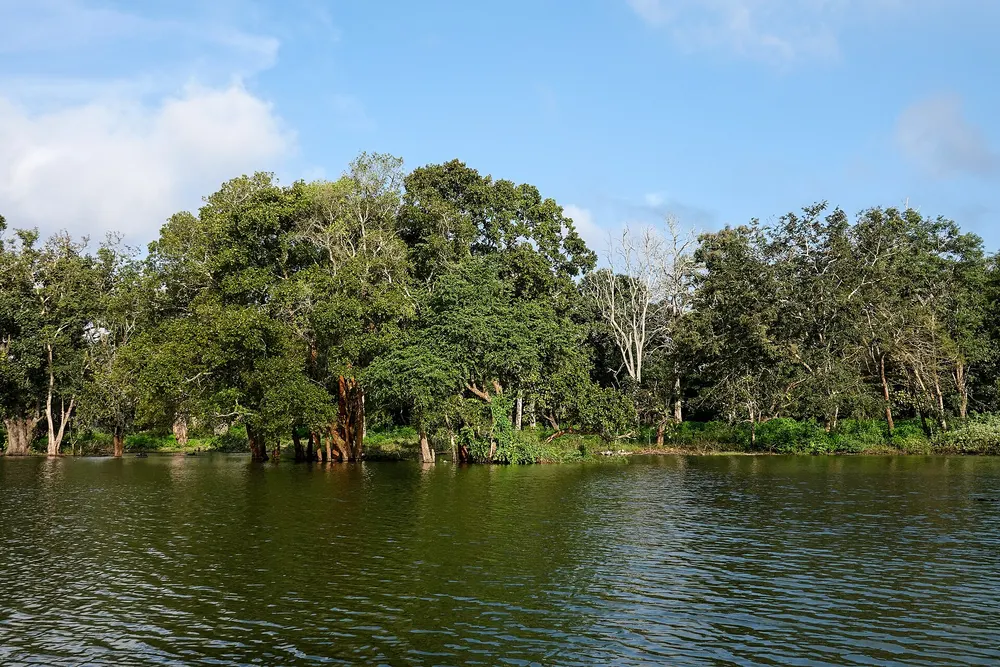
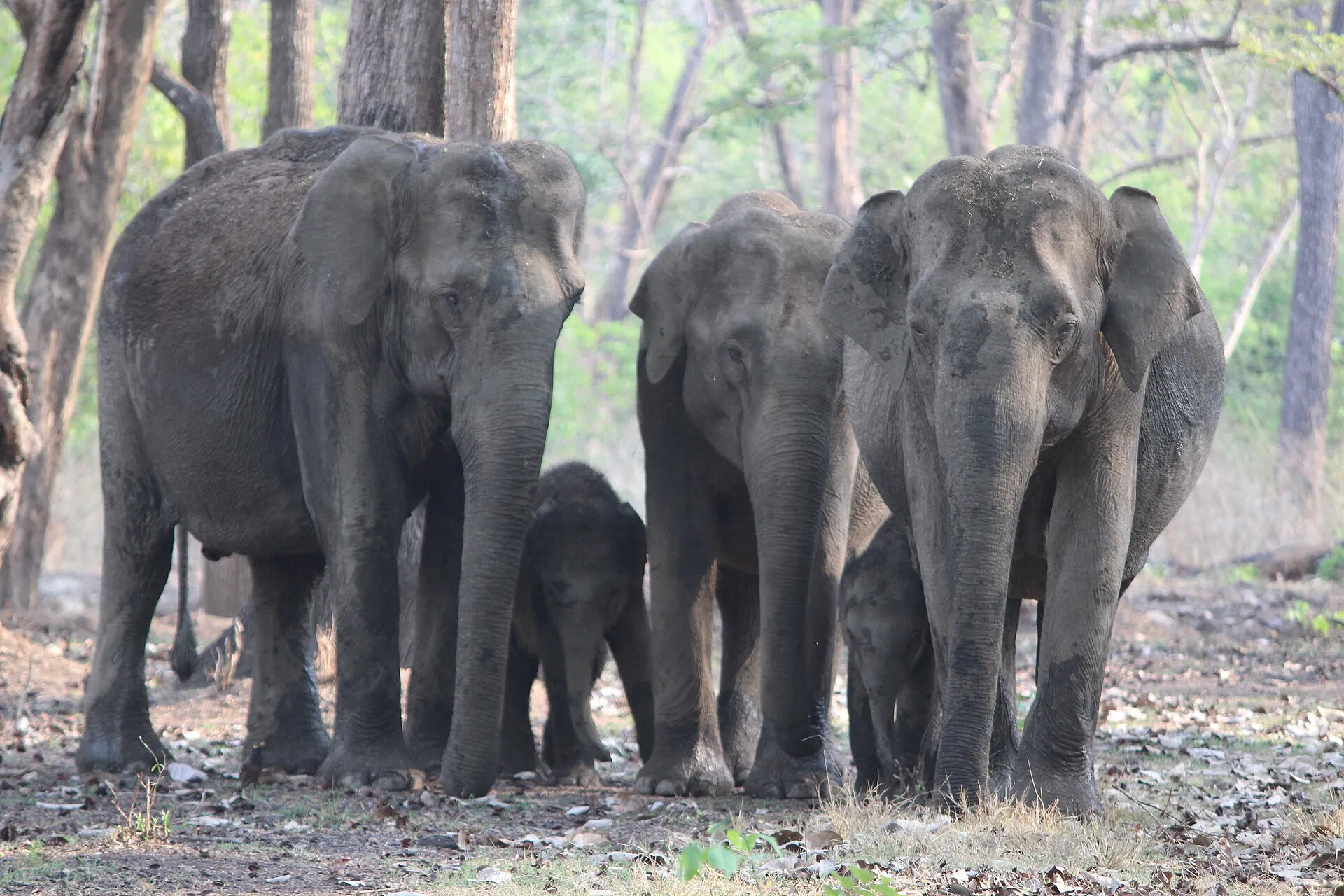
An elephant family with young calves at Kabini.
Safaris: gates, timings and fees
All tourist safaris in Nagarhole are run by the Forest Department; the reserve's rules state that safaris and other tourism activities are not entrusted to any travel agency or individual. Tickets are sold on the reserve's official ticket site, linked from nagaraholetigerreserve.com, and, at some gates and times, at the counter. The official ticket page, checked in November 2026, gives the following.
Booking window. Online bookings open 15 days in advance and close 48 hours before the safari. You register with a working mobile number for OTP verification and must carry the same original photo ID you booked with; foreign visitors need their passport. Report at the safari point 30 minutes before departure.
Rules worth knowing. Mobile phones are strictly prohibited in the core safari zones, including for photography. There are no toilet breaks, no getting out, no hands outside the vehicle, and no noise, food or plastic. Bookings cannot be cancelled by visitors; the department refunds only if it cancels. The rules also say a minimum of 10 seats per vehicle must be booked for a safari to run.
2025–2026. After a run of fatal tiger attacks in villages on the fringes of both reserves, the Karnataka government suspended safaris in Nagarhole and Bandipur in November 2025, allowed them to resume at half capacity in late February 2026, and approved full operation in June 2026 after a technical committee assessed carrying capacity. Check the ticket site for the current slots before you plan.
- Bus safari
- ₹1,000 per person above 12; ₹500 for children aged 3–12
- Jeep safari
- ₹1,500 per person above 12; ₹750 for children aged 3–12
- Camera fee
- ₹1,770 (incl. GST) for lenses above 200 mm
- Helpline (registration problems)
- +91 94482 12722, as listed on the ticket site
| Gate | Side | Morning | Afternoon | From Mysuru |
|---|---|---|---|---|
| Kakanakote | Kabini (south), via H.D. Kote | 06:30–09:30 | 15:00–18:00 | About 61 km |
| Veeranahosahally | Hunsur (east) | 06:00–09:00 | 15:00–18:00 | About 65 km |
| Nanachi | Kutta, Coorg side (west) | 06:00–09:00 | 15:00–18:00 | About 95 km |
Kabini or Bandipur?
They are the same tiger population and the same elephant herds, divided by a reservoir. The differences are practical: water, roads and stays.
Kabini is best from February to June, when the shoreline meadows draw animals into the open. Its stays are mostly upmarket resorts along the backwaters around N. Begur, Karapura and Antharasante, and its safaris start from one gate, Kakanakote, which keeps things simple. It is a dedicated wildlife trip, a little off the main road.
Bandipur sits on the Mysuru–Ooty highway, which makes it easy to combine with Ooty, Mudumalai and Mysuru, and it has more mid-range and budget options around Gundlupet and along the highway. Its forest is drier and more open in parts, and its safaris start from the Melukamanahalli counter. The comparison of all five parks sets out the details; the short answer is: Bandipur for a round trip, Kabini for a wildlife-only break, both if you can.
| Most flexibleKabini on your own | Kabini tour from Bengaluru | Kabini on a South India circuit | |
|---|---|---|---|
| Safari booking | You book on the official ticket site, 15 days to 48 hours ahead | Check the listing for safari arrangements | Check the listing for safari arrangements |
| Length | Two nights ideal | 2 days (per title) | Multi-day (see listing) |
| Also covers | Just the forest | Mysuru heritage | Mysuru, Ooty, Coimbatore |
| Transport | Your car or a taxi from Mysuru | Included per the listing | Included per the listing |
| Effortlower is better | ●●●●○ | ●●○○○ | ●●○○○ |
| Best for | Wildlife photographers and repeat visitors | A first Kabini trip with little time | A longer South India holiday |
| 2-day Kabini and Mysuru tour | Bengaluru to Coimbatore via Kabini |
-
Kabini on your own
Most flexible- Safari booking
- You book on the official ticket site, 15 days to 48 hours ahead
- Length
- Two nights ideal
- Also covers
- Just the forest
- Transport
- Your car or a taxi from Mysuru
- Effort
- ●●●●○
- Best for
- Wildlife photographers and repeat visitors
-
Kabini tour from Bengaluru
- Safari booking
- Check the listing for safari arrangements
- Length
- 2 days (per title)
- Also covers
- Mysuru heritage
- Transport
- Included per the listing
- Effort
- ●●○○○
- Best for
- A first Kabini trip with little time
-
Kabini on a South India circuit
- Safari booking
- Check the listing for safari arrangements
- Length
- Multi-day (see listing)
- Also covers
- Mysuru, Ooty, Coimbatore
- Transport
- Included per the listing
- Effort
- ●●○○○
- Best for
- A longer South India holiday
Editorial comparison, as checked November 2026. Fees and times from the official sites; tours described from their GetYourGuide titles.
Getting there
Kabini is about 61 km from Mysuru to the Kakanakote gate, via H.D. Kote (Heggadadevanakote), according to the reserve's ticket site; allow about 1.5 hours. From Bengaluru it is about 210 km via Mysuru. There is no public transport worth relying on for safari times; use your own car or a taxi from Mysuru.
From Bandipur, the reservoir is in the way. The road route runs north towards H.D. Kote and round the end of the backwaters; reckon on roughly two hours, depending on the route. That is why Kabini works best as a separate two-night stay rather than a day out from Bandipur, and why many itineraries go Mysuru – Kabini – Bandipur – Ooty in that order. See itineraries.
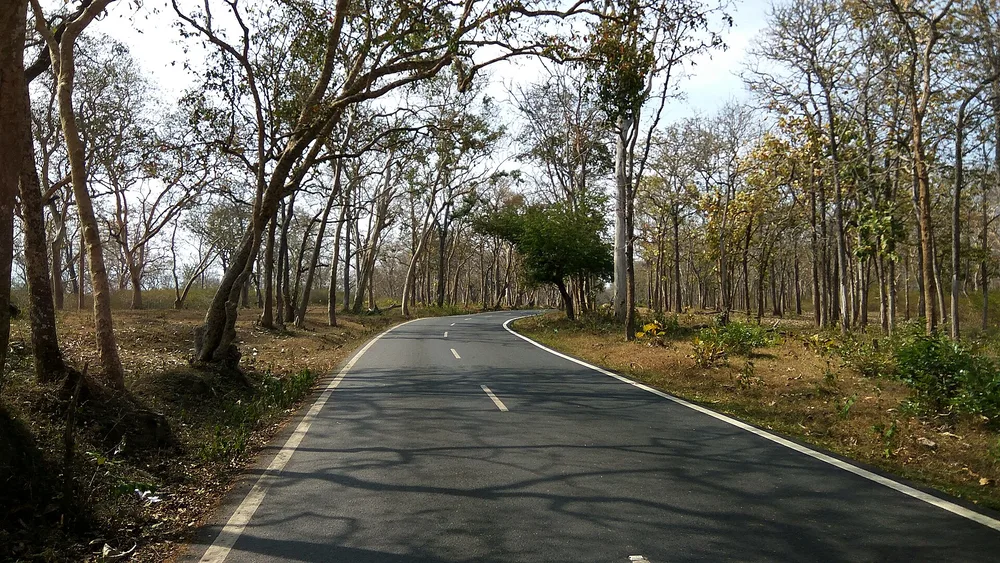
Plan your drives in daylight: elephants cross these roads at dusk and after dark, and you should never stop for animals on a forest road.
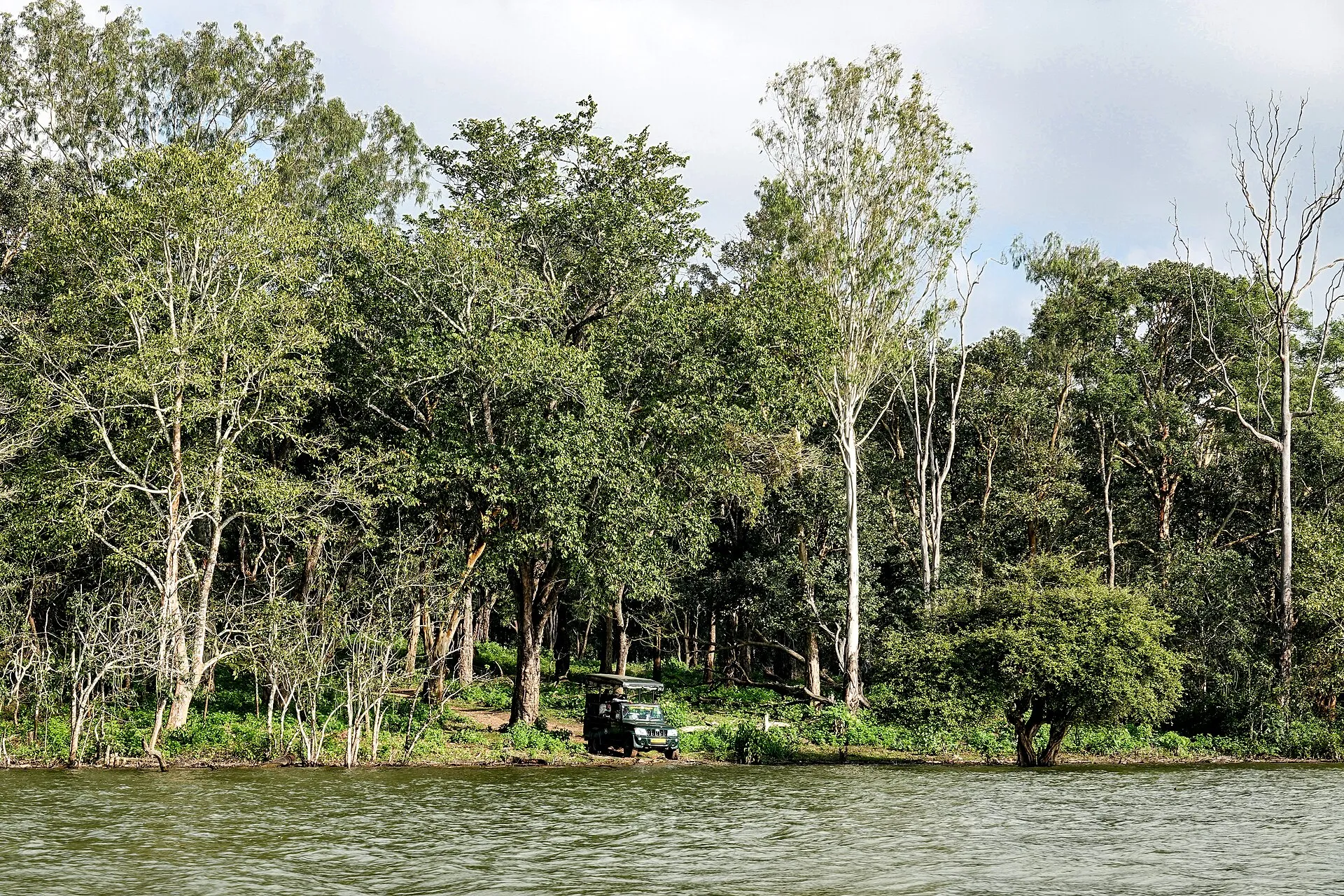
A safari jeep on the Kabini side of Nagarhole in December, with the reservoir behind.
Where to stay at Kabini
Kabini's stays line the southern shore of the backwaters in the H.D. Kote taluk, mostly a short drive from the Kakanakote gate. Many are full-board resorts that include their own activities and help with safari arrangements; check what each includes. For a budget option, H.D. Kote town is about 25 km from the gate. The properties below were checked against their Booking.com addresses in November 2026; Booking's Kabini search also returns places in Coorg and Wayanad, which are not near the Kabini gate.
The government-run Jungle Lodges' Kabini River Lodge books through its own channels and is not listed here.
Evolve Back Kabini
KabiniAt Bheeramballi on the Kabini backwaters, H.D. Kote taluk; two pools, spa, two restaurants, bar, airport shuttle.
9.5Booking.com guest score · as checked in November 2026
See on Booking.comThe Serai Kabini
KabiniAt Karapura, Antarasante hobli; outdoor pool, spa, fitness centre, restaurant, bar.
8.1Booking.com guest score · as checked in November 2026
See on Booking.comRed Earth Kabini
KabiniAt Badane Kuppe near Antharasante; outdoor pool, spa, restaurant, bar.
8.4Booking.com guest score · as checked in November 2026
See on Booking.comWaterwoods Lodge Kabini
KabiniAt Karapura near N. Belthur; two swimming pools, restaurant, airport shuttle, facilities for disabled guests.
8.5Booking.com guest score · as checked in November 2026
See on Booking.comDiscovery Village Kabini
KabiniAt Malalli Cross, N. Belathur; outdoor pool, spa, restaurant, family rooms.
7.9Booking.com guest score · as checked in November 2026
See on Booking.comAadvik Luxury Farmstay
KabiniOn the Kabini road at KG Halli; outdoor pool, room service, family rooms, fast free WiFi.
8.9Booking.com guest score · as checked in November 2026
See on Booking.comArasu Homestay
KabiniIn H.D. Kote town, about 25 km from the Kabini safari gate; two restaurants, family rooms, free WiFi.
9.0Booking.com guest score · as checked in November 2026
See on Booking.comSee all stays in Kabini on Booking.com
Accommodation links go to Booking.com, where you see live prices and availability. We do not list prices because they change daily; BandipurNationalPark.com may earn a commission.
Book a Kabini safari trip
If you would rather not deal with the ticket site's 15-day window and the drive, the two-day Kabini tour from Bengaluru and the longer circuits below handle it for you. Check every listing for which safari is included.
Frequently asked questions
Is Kabini the same as Nagarhole?
Kabini is the southern side of Nagarahole Tiger Reserve, on the backwaters of the Kabini dam. Safaris on that side start from the Kakanakote gate.
How do I book a Nagarhole or Kabini safari?
On the official ticket site linked from nagaraholetigerreserve.com. Bookings open 15 days ahead and close 48 hours before; register with a mobile number and bring the same photo ID (a passport for foreign visitors).
How much does a Kabini safari cost?
As checked on the official ticket page in November 2026: bus ₹1,000 and jeep ₹1,500 per person above 12, half for children aged 3–12, and ₹1,770 for cameras with lenses above 200 mm.
Can I use my phone on a Kabini safari?
No. The ticket site says mobile phones are strictly prohibited in the core safari zones, including for photography.
Is Kabini better than Bandipur?
Not better, different. Kabini is outstanding in the dry season along the backwaters and has mostly upmarket stays; Bandipur is easier to combine with Mysuru, Ooty and Mudumalai.
When is the best time for Kabini?
February to June, when the reservoir recedes and animals gather on the shoreline. July to October is greener with more scattered sightings.
Sources and official information
Facts were checked against these official and scholarly sources in November 2026. Opening hours, ticket prices, park fees and timetables change, so confirm before you go.
- nagaraholetigerreserve.com
- ticket.nagaraholetigerreserve.com
- nagaraholetigerreserve.com
- nagaraholetigerreserve.com
- siasat.com
- theprint.in
- junglelodges.com
- ntca.gov.in
- en.wikipedia.org
BandipurNationalPark.com is an independent guide. It is not the official website of Bandipur National Park or Tiger Reserve and is not affiliated with the Karnataka Forest Department, any government body, tour operator or resort; official safari bookings are made on the government's own portal. Some links are affiliate links: tours go to GetYourGuide and accommodation goes to Booking.com, and we may earn a commission at no extra cost to you.